Do people know how much power and status they have?

Do you know how much power and status you have in the important social situations in your life? Cameron Anderson and I have a chapter coming out in a few months looking at that question. The chapter is titled “Accurate When It Counts: Perceiving Power and Status in Social Groups.” (It draws in part on an earlier empirical paper we did together.) The part before the colon probably gives away a little bit of the answer. We present a case that most people, much of the time, are pretty good at perceiving their own and others’ power and status. (Better than they are at perceiving likability or personality traits.)

You can read the chapter if you want to see where the main point is coming from. I just want to briefly comment on a preliminary issue we had to develop along the way…

One of the fun things about writing this paper was working out what it means to be accurate in perceiving power and status. Accuracy has a long and challenging history in social perception research. How do you quantify how well somebody knows somebody else’s (or their own) likability, extraversion, morality, or — in our case — power or status?

We started by creating working definitions of power and status. What became clear along the way is that the accuracy question gets answered differently for power than for status because of the different definitions. For power, we adopted Susan Fiske’s definition that power is asymmetric outcome control (in a nutshell, Person A has power over Person B if A has control over B’s valued outcomes). For status, we defined it as respect and influence in the eyes of others.

Drawing on those definitions, here’s what we say about how to define accuracy in perceiving power:

The outcome-control framework is useful for studying perceptions. Outcome control is a structural property of relationships that does not depend on any person’s construal of a situation. Thus, one person may have power over another person even if one or both people do not realize it at a given time. (For example, a late-night TV host and the female intern he dates might both think about their relationship in purely romantic terms, but the fact that the host makes decisions about the intern’s salary and career advancement means that he has power over her). Because the outcome-control framework separates psychological processes such as the perception of power from power per se, it is conceptually coherent to ask questions about the accuracy of perceptions.

And here’s how accuracy is different for status:

Like power, status is a feature of a relationship (Fiske & Berdahl, 2007). Like power, status may vary from one situation to another. And like with power, it is possible for a single individual to misperceive her own status or the status of another person. However, because status is about respect and prestige in the eyes of others, at its core it involves collective perceptions – that is, status is a component of reputation. Thus status is socially constructed in a different and perhaps more fundamental way than power. Whereas it might make sense to say that an individual has power but nobody knows it, it would not make sense to say the same about status. This gives status a complicated but necessary relation to interpersonal perceptions, which will become important when we consider what it means to be accurate in perceiving status.

On a side note: egads, am I becoming a social constructivist?

Reference:

Srivastava, S. & Anderson, C. (in press). Accurate when it counts: Perceiving power and status in social groups. In J. L. Smith, W. Ickes, J. Hall, S. D. Hodges, & W. Gardner (Eds.), Managing interpersonal sensitivity: Knowing when—and when not—to understand others.
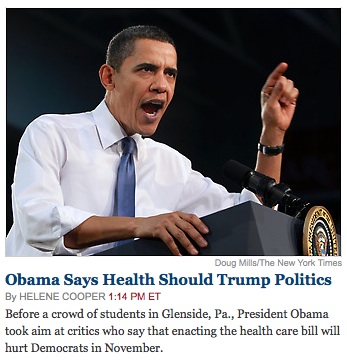
Does that include midterms?

Okay, so just now when I saw this

… I immediately thought of this:

Tetlock, P. E. (1981). Pre- to postelection shifts in presidential rhetoric: Impression management or cognitive adjustment. Journal of Personality and Social Psychology, 41, 207-212.

Used content analysis to assess the conceptual or integrative complexity of pre- and post-election policy statements of 20th-century American presidents. Two hypotheses were tested. According to the impression management hypothesis, presidents present issues in deliberately simplistic ways during election campaigns but in more complex ways upon assuming office when they face the necessity of justifying sometimes unpopular decisions to skeptical constituencies. According to the cognitive adjustment hypothesis, presidents gradually become more complex in their thinking during their tenure in office as they become increasingly familiar with high-level policy issues. Results support only the impression management position. The complexity of presidential policy statements increased sharply immediately after inauguration but did not increase with length of time in office. Complexity of policy statements also significantly declined in reelection years.

I haven’t coded the transcript for integrative complexity yet. But when the reporter writes, “Mr. Obama has been seeking to narrow the complex arguments over health care policy,” it sounds a heck of a lot like what Tetlock was talking about.

Perceiver effects in interpersonal perception

Hot off the presses is a paper I wrote with Steve Guglielmo and Jenni Beer on perceiver effects in the Social Relations Model. Here’s the abstract:

In interpersonal perception, “perceiver effects” are tendencies of perceivers to see other people in a particular way. Two studies of naturalistic interactions examined perceiver effects for personality traits: seeing a typical other as sympathetic or quarrelsome, responsible or careless, and so forth. Several basic questions were addressed. First, are perceiver effects organized as a global evaluative halo, or do perceptions of different traits vary in distinct ways? Second, does assumed similarity (as evidenced by self-perceiver correlations) reflect broad evaluative consistency or trait-specific content? Third, are perceiver effects a manifestation of stable beliefs about the generalized other, or do they form in specific contexts as group-specific stereotypes? Findings indicated that perceiver effects were better described by a differentiated, multidimensional structure with both trait-specific content and a higher order global evaluation factor. Assumed similarity was at least partially attributable to trait-specific content, not just to broad evaluative similarity between self and others. Perceiver effects were correlated with gender and attachment style, but in newly formed groups, they became more stable over time, suggesting that they grew dynamically as group stereotypes. Implications for the interpretation of perceiver effects and for research on personality assessment and psychopathology are discussed.

A couple of quick comments to add:

  • This is an example of using the Big Five / Five-Factor Model not as a model of personality per se, but as a model of social perception. I very briefly mention this potential use of the Big Five in my guide to measuring the Big Five, and I’m currently working on a manuscript expanding on this idea. (BTW, I’m certainly not the first person to think of the Big Five in this way. I’m trying to carry this idea forward a bit, but it’s one of those cases where I oscillate between thinking what I’m saying about it is radically new and thinking ho-hum-we-already-thought-of-that.)
  • While we were working on this manuscript, I became aware that a group led by Dustin Wood was looking at very similar issues (but with some interesting differences in approach and areas of non-overlap). They’ve got a paper in press at JPSP.

If you want to read more you can download the PDF:

Srivastava, S., Guglielmo, S., & Beer, J. S. (2010). Perceiving others’ personalities: Examining the dimensionality, assumed similarity to the self, and stability of perceiver effects. Journal of Personality and Social Psychology, 98, 520-534.

Take the DSM-5 disorder quiz!

Below are the names of some psychological disorders. For each one, choose one of the following:

A. This is under formal consideration to be included as a new disorder in the DSM-5.

B. Somebody out there has suggested that this should be a disorder, but it is not part of the current proposal.

C. I made it up.

Answers will be posted in the comments section.

1. Factitious dietary disorder – producing, feigning, or exaggerating dietary restrictions to gain attention or manipulate others

2. Skin picking disorder – recurrent skin picking resulting in skin lesions

3. Olfactory reference syndrome – preoccupation with the belief that one emits a foul or offensive body odor, which is not perceived by others

4. Solastalgia – psychological or existential stress caused by environmental changes like global warming

5. Hypereudaimonia – recurrent happiness and success that interferes with interpersonal functioning

6. Premenstrual dysphoric disorder – disabling irritability before and during menstruation

7. Internet addiction disorder – compulsive overuse of computers that interferes with daily life

8. Sudden wealth syndrome – anxiety or panic following the sudden acquisition of large amounts of wealth

9. Kleine Levin syndrome – recurrent episodes of sleeping 11+ hours a day accompanied by feelings of unreality or confusion

10. Quotation syndrome – following brain injury, speech becomes limited to the recitation of quotes from movies, books, TV, etc.

11. Infracaninophilia – compulsively supporting individuals or teams perceived as likely to lose competitions

12. Acquired situational narcissism – narcissism that results from being a celebrity

Error variance and humility

I often hear researchers criticize each other for treating important phenomena as error variance. For example, situationist social psychologists criticize trait researchers for treating situations as error variance, and vice versa. (And us interactionists get peeved at both.) The implication is that if you treat something as error variance, you are dismissing it as unimportant. And that’s often how the term is used. For example, during discussions of randomized experiments, students who are learning how experiments work will often wonder whether pre-existing individual differences could have affected the outcomes. A typical response is, “Oh, that couldn’t have driven the effects because of randomization. If there are any individual differences, they go into the error variance.” And therefore they get excluded from the explanation of the phenomenon.

I think we’d all be better off if we remembered that the word “error” refers to an error of a model or theory. On the first day of my grad school regression course, Chick Judd wrote on the board: “DATA = MODEL + ERROR”. A short while later he wrote “ERROR = DATA – MODEL.” Error is data that your model cannot explain. Its existence is a sign of the incompleteness of your model. Its ubiquity should be a constant reminder to all scientists to stay humble and open-minded.

Learning styles and education: good practice requires good science

Cedar Riener has a terrific article on learning styles and cognitive science in the latest Teacher Magazine. The piece, Learning Styles: What’s Being Debunked, concerns Hal Pashler and colleagues’ recent review of the lack of evidence for learning styles, which was published in Psychological Science in the Public Interest and which I’ve talked about before.

Cedar’s piece is a rebuttal to a critique [subscription required] published in Teacher. In it he does several important things. First, he clarifies what the theory of multiple learning styles is, and he makes clear how that theory is different from other perspectives on individual differences in how students learn (such as theories that posit multiple ability domains, or student diversity based on cultural background). He restates Pashler et al.’s central arguments and findings — in short, that there is zero empirical evidence for the existence multiple learning styles.

Second, he discusses the real costs of building one’s teaching practice around a theory of learning styles. Teachers have finite time and resources. If they focus their efforts on teaching the same content in multiple sensory modalities (as learning-styles advocates tell them they must), they will necessarily have less time and energy to do other things that might have real benefits for students.

Third, Cedar makes a broader case for the critical role that cognitive science can and should play in shaping classroom practices. The critique he is responding to is disdainful of science, preferring an individual teacher’s idiosyncratic observations and pet theories over practices supported by real evidence. Educators need to embrace the science of learning; but Cedar also calls psychologists to task for not doing a better job of speaking to policymakers and practitioners:

We must also dispel myths, and we in psychology have a larger set of myths to dispel than others. When these myths exist, they are corrosive to science, because while seeming to represent science (“well, it says it’s a theory”) they do not provide the measurable, reliable results that science demands. These myths are perpetuating identity theft of science, calling themselves science and wrecking havoc on our credit scores, yet many scientists don’t connect the bankruptcy of public trust in science with the myths that we let roam freely… As scientists we must take greater efforts to rein in this misapplication of science.

In this vein, I’d say psychology has an important but difficult task ahead of itself. If you look at the applied domain where psychology has traditionally been the most involved — clinical treatment of mental disorders — the shift toward evidence-based treatment has been slow, though it is finally picking up momentum and having real benefits. Hooray for those like Cedar, Hal Pashler, and Daniel Willingham who are pushing for the same in educational practice.

UPDATE: If you want to read Heather Wolpert-Gawron’s critique (the one that inspired Cedar’s article in response), you can read it on her blog, no subscription required, at TweenTeacher.com.

Statisticians to Olympic figure skaters: Give up!

The NY Times has a clever bit of number-crunching of men’s figure skating on their website.

In figure skating, quad jumps (jumps with 4 aerial rotations) are worth a lot of points, but only if they are executed successfully. If you mess up, a quad is worth less than a successful execution of an easier triple. The Times combed through records of Olympic athletes’ previous performances and computed the points earned on quad jump attempts. They then compared the expected value of quad jumps to the value of a successful triple, and they concluded that it’s not worth even trying a quad. In the long run, a figure skater will score more points doing triples. (This assumes that the athletes in question are good enough that they could pretty much guarantee sticking a triple.)

Of course, as Keynes famously said, in the long run we’re all dead. Medals aren’t awarded on long-run averages; they’re based on a single performance. If everybody else is trying quads and you’re not, odds are that someone else will stick one. In a single performance, individuals can capitalize on chance.

But perhaps there are other hidden costs. The Times doesn’t discuss individual differences, but according to their data, Yevgeny Plushenko has a 100% success rate executing quad jumps. So if you just look at the numbers for quad jumps, you might conclude that it is always worthwhile for Plushenko to attempt quads. Yet Plushenko, who successfully stuck a high-scoring quad combo, only won the silver, and he was beaten out by a competitor who didn’t even try a quad. I’m not enough of an expert to say why that happened, but if Plushenko spent so much time practicing his quad jumps that he didn’t perfect other elements of his routine… well, maybe the Times’s conclusion is right after all (just not for the reasons they give).

The Five-Factor Model in the DSM-5

Via Neuroskeptic, I just found out that the Big Five have been proposed to appear (sorta) in the DSM-5.

The current Axis II disorders will be replaced by a mixture of continuously-rated personality disorder types (carrying forward psychopathy, avoidant, borderline, obsessive-compulsive, and schizotypal) and 6 personality traits. According to the rationale, four of the traits are pathological versions of 4 of the Big Five (Openness/Intellect apparently doesn’t have a pathological extreme).

I need to read more about it, but it’s not clear to me how redundant the types and traits will be, and whether that’s by design. For example, the typology includes a schizitypal type, and the trait space includes a schizotypy dimension (the latter based on David Watson’s work suggesting that trait terms referring to oddness/eccentricity should not have been excluded from the lexical sampling that produced the Big Five). Both are continuously rated — will they provide complementary information, or will they just say the same thing?

One good thing, though, is the shift toward using continuous ratings rather than yes/no categories. This will potentially create practical problem for the healthcare system (if something is continuous, at what point do you decide that insurance will reimburse treatment?), but scientifically it is better in line with what we know about the underlying nature of personality and personality disorders.

Evidence that people underestimate the difficulty of psychology

Pertaining to the name of this blog

In 4 studies, the authors examined how intuitions about the relative difficulties of the sciences develop. In Study 1, familiar everyday phenomena in physics, chemistry, biology, psychology, and economics were pretested in adults, so as to be equally difficult to explain. When participants in kindergarten, Grades 2, 4, 6, and 8, and college were asked to rate the difficulty of understanding these phenomena, children revealed a strong bias to see natural science phenomena as more difficult than those in psychology. The perceived relative difficulty of economics dropped dramatically in late childhood. In Study 2, children saw neuroscience phenomena as much more difficult than cognitive psychology phenomena, which were seen as more difficult than social psychology phenomena, even though all phenomena were again equated for difficulty in adults. In Study 3, we explored the basis for these results in intuitions about common knowledge and firsthand experience. Study 4 showed that the intuitions about the differences between the disciplines were based on intuitions about difficulty of understanding and not on the basis of more general intuitions about the feasibility or truth of the phenomena in question. Taken together, in the studies, the authors find an early emerging basis for judgments that some sciences are intrinsically more difficult than others, a bias that may persevere in adults in subtler forms in such settings as the courtroom.

Source: Keil, F. C., Lockhart, K. L., & Shlegel, E. (2010). A bump on a bump? Emerging intuitions concerning the relative difficulty of the sciences. Journal of Experimental Psychology: General, 139, 1-15. [pdf available]

I rest my case.

The parliamentary table metaphor

In parliamentary procedure, when you want to suspend discussion of a motion, you “lay it on the table.” And when you want to put it back into consideration, you “take it from the table.”

My department uses Robert’s Rules for faculty meetings, and I have always found this confusing. A big part of my confusion comes from the fact that we meet around a big conference table. So if you were to lay something on the table, it would be at the focus of everybody’s attention.

To date I have been unable to overcome this interference by sheer rote memorization of the terms “lay on the table” and “take off the table.” But I have found it marginally effective to summon up a competing metaphor. Lucky for me, our meeting room has another, smaller table on the side, away from most people’s attention. So in order to remember what the terms mean, I remind myself to think of the side table when I visualize the metaphor, which usually does the trick.

As I often think to myself when I make these weird introspective observations: there must be a dissertation in there somewhere.

p.s. It turns out that I’m not the only person who’s confused by this. Wikipedia says that in Britain the table metaphor is reversed from the American usage, which has apparently led to some serious cross-cultural miscommunication in the past.